Testing a deck involves more than choosing cards. It means trying opening hands, exploring matchups, and learning how decisions play out. At the table, the focus shifts to scores, experience points, and keeping a match moving.
I built Just a Rift Sim around those two moments: practicing independently and playing in person. The design challenge was to bring both into a compact mobile experience, with controls that fit the task at hand.
02 / The experience
One app. Two ways to play.
01
Practice before the match
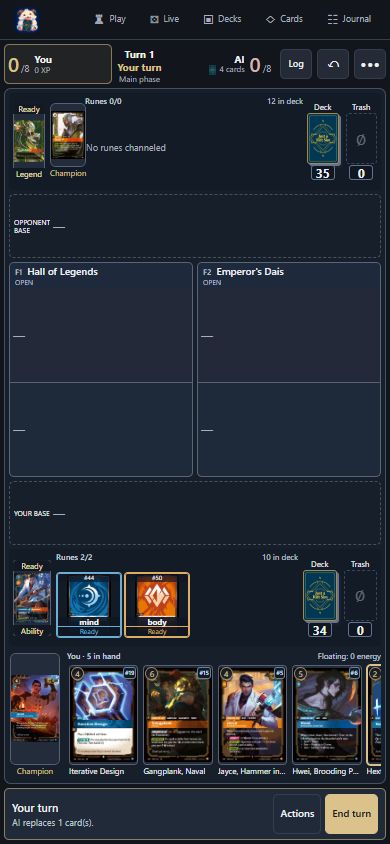
Build or import a deck, test opening hands, and try a matchup against the practice AI. Control both sides to explore a specific interaction, or play a best-of-three series with sideboarding between games.
Saved matches and undo let you revisit decisions, while exportable replays preserve a record of each game.
02
Keep the table moving
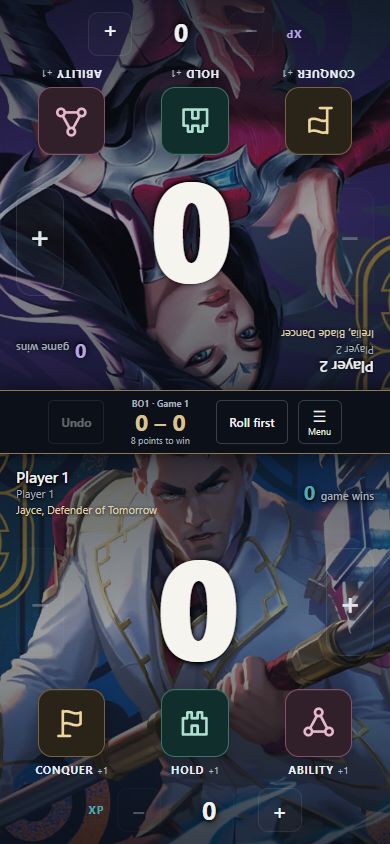
Live mode turns one shared device into a tabletop scorekeeper. It tracks scores and XP across 1v1, 2v2, and three- or four-player free-for-all games.
Panels face each player, scoring actions have distinct symbols, and legend artwork makes each seat easy to recognize.
03 / Design decisions
Built around the people at the table.
Readable from either seat
Opposing scorecards rotate toward each player. Large scores and distinct Conquer, Hold, and Ability controls keep frequent actions within reach.
Personal, without losing clarity
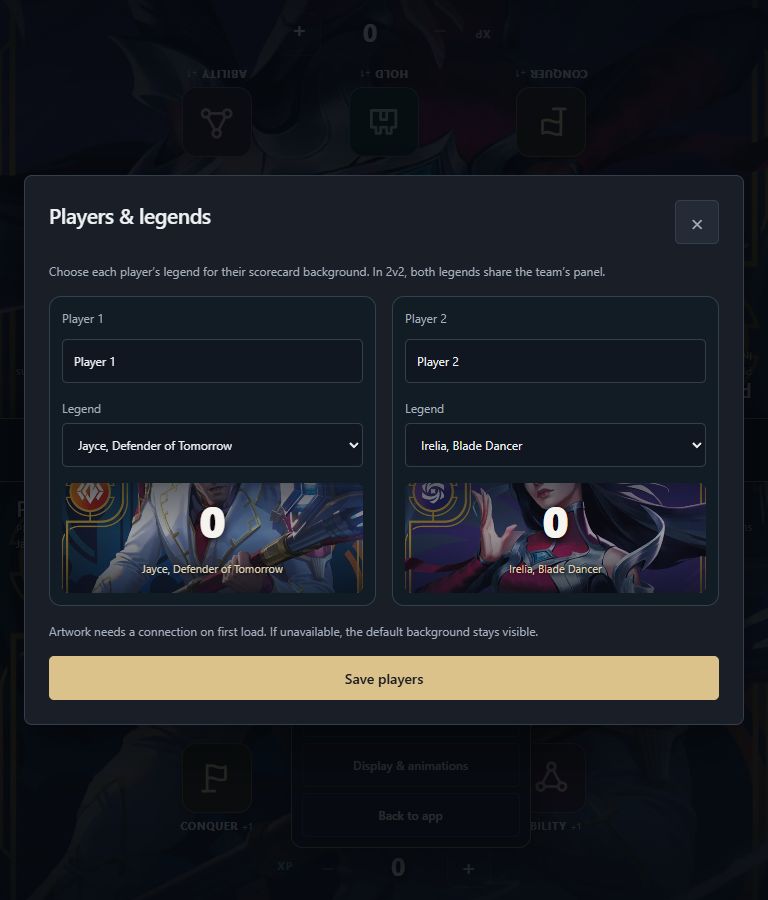
Players choose their names and legends before a match. A preview shows the result, while dark overlays keep the scores readable over the artwork.
Easy to pick up again
Saved tables and persistent player choices carry across restarts and rematches. Undo makes accidental scoring changes reversible.
Live mode: personalize each scorecard before the match.
04 / Under the hood
From interface to working app.
The interface uses HTML, CSS, and JavaScript, with a JavaScript rules engine handling match state and card interactions. A Java Android WebView wrapper packages the experience as an installable app.
HTML
CSS
JavaScript
Java
Android WebView
Local persistence
Gameplay and saved decks work offline. Card and legend artwork can require an initial connection. Keeping the rules engine separate from the interface supports focused iteration on game behavior and mobile usability.
05 / The result
A playable personal project.
The result is a working Android alpha that connects deck preparation, solo practice, and in-person scorekeeping. This project brings together my interest in games, thoughtful interaction design, and building usable software.
Unofficial Riftbound fan project. Riftbound and the card artwork belong to Riot Games. Not affiliated with or endorsed by Riot Games.